

Ammonium Carbonate Decomposition Balanced Equation
 | |
 | |
 | |
| Names | |
|---|---|
| IUPAC name Ammonium carbonate | |
Other names
| |
| Identifiers | |
| CAS Number |
|
| 3D model (JSmol) |
|
| ChemSpider |
|
| ECHA InfoCard | 100.007.326 |
| EC Number |
|
| E number | E503(i) (acidity regulators, ...) |
| IUPHAR/BPS |
|
| PubChem CID |
|
| UNII |
|
| Un number | 3077 |
| CompTox Dashboard (EPA) |
|
| InChI
| |
| SMILES
| |
| Properties | |
| Chemic formula | (NHiv)twoCO3 |
| Molar mass | 96.09 thousand/mol |
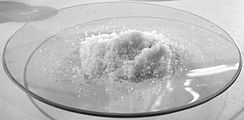
| Appearance | White powder |
| Density | 1.fifty grand/cm3 |
| Melting point | 58 °C (136 °F; 331 K) (decomposes) |
| Solubility in water | 100 g/100 ml (fifteen°C)[1] 25 g/100 ml (20°C) |
| Magnetic susceptibility (χ) | -42.50·10−half-dozen cm3/mol |
| Hazards | |
| Occupational safety and health (OHS/OSH): | |
| Main hazards | Irritant |
| GHS labelling: | |
| Pictograms |  |
| Indicate word | Alert |
| Gamble statements | H302, H319 |
| Safety data canvass (SDS) | External MSDS |
| Related compounds | |
| Other anions | Ammonium bicarbonate Ammonium carbamate |
| Other cations | Sodium carbonate Potassium carbonate |
| Except where otherwise noted, data are given for materials in their standard state (at 25 °C [77 °F], 100 kPa). Infobox references | |


Ammonium carbonate is a table salt with the chemical formula (NH4)2COthree. Since it readily degrades to gaseous ammonia and carbon dioxide upon heating, it is used every bit a leavening agent and as well equally smelling table salt. It is also known as baker's ammonia and was a predecessor to the more modern leavening agents blistering soda and baking pulverization. It is a component of what was formerly known equally sal volatile and table salt of hartshorn,[2] and produces a pungent smell when baked.
Production [edit]
Ammonium carbonate is produced by combining carbon dioxide and aqueous ammonia. About 80,000 tons/year were produced every bit of 1997.[2]
An orthorhombic monohydrate is known. It crystallizes in an ammonia solution exposed in a carbon dioxide-rich atmosphere.[3]
Decomposition [edit]
Ammonium carbonate slowly decomposes at standard temperature and pressure through ii pathways. Thus any initially pure sample of ammonium carbonate will presently become a mixture including diverse byproducts.
Ammonium carbonate can spontaneously decompose into ammonium bicarbonate and ammonia:
- (NH4)iiCO3 → NH4HCOthree + NH3
Which further decompose to carbon dioxide, water and another molecule of ammonia:
- NH4HCOthree → HiiO + CO2 + NH3
Uses [edit]
Leavening agent [edit]
Ammonium carbonate may be used as a leavening agent in traditional recipes, specially those from northern Europe and Scandinavia (e.g. Amerikaner, Speculoos, Tunnbröd or Lebkuchen). It was the precursor to today'due south more than commonly used baking pulverization.
Originally made from footing deer horn and chosen hartshorn, today it is called baker'due south ammonia. Information technology is prepared by the sublimation of a mixture of ammonium sulfate and calcium carbonate and occurs every bit a white powder or a hard, white or translucent mass.[4] It acts as a oestrus activated leavening amanuensis and breaks down into carbon dioxide (leavening), ammonia (which needs to dissipate) and water. It is sometimes combined with sodium bicarbonate to mimic equally a double acting baking pulverisation and to help mask whatever ammonia odor not broiled out.
Information technology besides serves as an acidity regulator and has the E number E503. It tin be replaced with blistering pulverisation, but this may affect both the gustatory modality and texture of the finished product. Baker's ammonia should be used to create thin dry baked appurtenances like crackers and cookies. This allows the strong ammonia smell to broil out. It should not exist used to make moist baked items like cake since ammonia is hydrophilic and volition leave a strong bitter taste.
Its use as a leavening amanuensis, with associated controversy, goes back centuries:
In the third kind of breadstuff, a vesicular appearance is given to it by the addition to the dough of some ammoniacal salt, (usually the sub-carbonate,) which becomes wholly converted into a gaseous substance during the process of baking, causing the dough to swell out into little air vessels, which finally bursting, allow the gas to escape, and leave the bread exceedingly porous. Mr. Accum, in his Treatise on Culinary Poisons, has stigmatized this process as "fraudulent," but, in our opinion, almost unjustly. The bakers would never prefer it but from necessity: when skilful yeast cannot be procured, information technology forms an beauteous and perfectly harmless substitute; costing the baker more than, information technology diminishes his profit, while the consumer is benefited by the breadstuff retaining the solid matter, which past the process of fermentation is dissipated in the form of alcohol and carbonic acid gas.[five]
Other uses [edit]
Ammonium carbonate is the main component of smelling salts, although the commercial calibration of their production is minor. Buckley'south coughing syrup from Canada today uses ammonium carbonate every bit an agile ingredient intended to assist relieve symptoms of bronchitis. It is also used as an emetic. It is also constitute in smokeless tobacco products, such as Skoal, and it is used in aqueous solution as a photographic lens cleaning agent, such as Eastman Kodak's "Kodak Lens Cleaner."
It is also used for luring of apple maggots in Washington State, to monitor the spread of the infestation and adjust the borders of the Apple Maggot Quarantine Area.[half dozen]
See also [edit]
- Ammonium bicarbonate
- Ammonium nitrate
- Sal ammoniac, the mineralogical form of ammonium chloride
References [edit]
- ^ John Rumble (June eighteen, 2018). CRC Handbook of Chemistry and Physics (99th ed.). CRC Press. pp. 4–40. ISBN978-1138561632.
- ^ a b Karl-Heinz Zapp (2012). "Ammonium Compounds". Ullmann's Encyclopedia of Industrial Chemical science. Weinheim: Wiley-VCH. doi:10.1002/14356007.a02_243. ISBN978-3527306732.
- ^ Fortes, A.D.; Wood, I.Thou.; Alfè, D.; Hernàndez, E.R.; Gutmann, 1000.J.; Sparkes, H.A. (2014-12-01). "Construction, hydrogen bonding and thermal expansion of ammonium carbonate monohydrate". Acta Crystallographica Section B. 70 (6): 948–962. doi:10.1107/S205252061402126X. ISSN 2052-5206. PMC4468514. PMID 25449618. Retrieved 2021-08-xx .
- ^ "CFR - Code of Federal Regulations Title 21". www.accessdata.fda.gov . Retrieved 2018-02-07 .
- ^ "Bread". The Engineer's and Mechanic's Encyclopedia. Vol. 1. Luke Hebert. 1849. p. 239.
- ^ Yee, Wee 50.; Nash, Meralee J.; Goughnour, Robert B.; Cha, Dong H.; Linn, Charles E.; Feder, Jeffrey L. (2014). "Ammonium Carbonate is More Attractive Than Apple and Hawthorn Fruit Volatile Lures to Rhagoletis pomonella(Diptera: Tephritidae) in Washington State". Environmental Entomology. 43 (4): 957–968. doi:ten.1603/en14038. PMID 24915519. S2CID 31174719.

Ammonium Carbonate Decomposition Balanced Equation,
Source: https://en.wikipedia.org/wiki/Ammonium_carbonate
Posted by: fiorinifoused48.blogspot.com
0 Response to "Ammonium Carbonate Decomposition Balanced Equation"
Post a Comment