

How Does Density Affect Refraction
In this article, we will discuss the effect of refraction on wavelength while propagating from one medium to some other, with detailed facts.
The frequency of the moving ridge does non vary on refraction of the moving ridge, hence, the wavelength of the moving ridge is directly proportional to its speed. As the speed of the wave varies on traversing from mediums, the wavelength also shifts accordingly.
Does Refraction Bear upon Wavelength?
The refraction occurs when the ray of light travels from medium to another.
The velocity of the moving ridge increases while traversing from the rarer mediums and decreases in denser mediums that determines the bending of refraction. The wavelength of the wave is relative to the velocity and varies parallelly.
We know that, the speed of the lite c=λf. For whatsoever moving ridge, propagating from 2 unlike mediums, moving with speed 'v' is directly proportional to the wavelength, equally the frequency of the wave remains the same after refraction.
The velocity of the moving ridge in the medium is straight dependent on the refractive index of the medium it is traversing through.
nane/n2 = 52/v1
fivetwo/vone=λ2f/λ1f
Every bit the frequency remains abiding even after refraction,
52/five1=λ2/λ1
Hence,
north1/n2=λii/λ1
The refraction of the wave depends upon the wavelength and the wavelength is inversely proportional to the refractive index of the medium.
Read more on Types Of Refraction: Comparative Assay.
How does Refraction Affect Wavelength?
The refraction may increase or decrease the wavelength of the light or audio propagating in the medium having higher density than the air.
When a wave travels in the denser medium the speed of the wave decreases and hence the wavelength decreases. The wavelength increases if the speed of the wave increases while traveling in a rarer medium.
Consider a moving ridge propagating from rarer medium to denser medium and back to the rarer medium equally shown in the beneath effigy.

The velocity of the wave in the rarer medium is more and hence the wavelength of the moving ridge is increased. On passing to the denser medium having a slightly greater refractive index, the speed of the wave and the wavelength reduces. On entering back to the rarer medium, the wavelength and speed of the wave increase.
Read more on What is the wavelength of photon: How to Notice, Several Insights And Facts.
How does Index of Refraction Affect Wavelength?
The denser the medium, the velocity of the wave will decrease and hence the wavelength reduces.
The index of refraction is greater for the denser medium than the rarer because the speed and in proportionate the wavelength of the moving ridge is reduced while traveling through the denser medium.
The refractive alphabetize of the medium is given as the velocities of the wave propagating from ii different mediums. Suppose the lite travels from medium i to medium ii, the refractive index of the medium is given as
n12=n1/due north2=λ2/λ1
Where due north1 is a refractive alphabetize of medium 1
ntwo is a refractive index of medium ii
v1 is a velocity of light in medium 1
vtwo is a velocity of light in medium 2
The speed of the moving ridge is equal to the production of the wavelength and the frequency of the wave.
v=λ f
Permit usa take an example to clarify how does the wavelength of the wave depends upon the refractive index of the medium it is traveling through.
Read more on Refractive Index.
Example: Consider a wave of calorie-free propagating from air to water. If the frequency of the wave is equal to 6* 1016 /sec. Calculate the change in the wavelength of the light.
Given: f=six* 1016 /sec
Refractive index of air due north1=one
Refractive index of h2o n2=1.33
n=c/v
north=c/λf
λ=c/nf
This shows that the wavelength is inversely proportional to the refractive index of the medium.
Wavelength of the light in air was
λi=c/north1f
λ1=3* 108 / i* half dozen * 10sixteen
λane=5*107=500*10-9=500nm
After refraction, the wavelength of the light in water becomes
λii=c/northward2f
λ2=three* 108/ 1.33* 6* tensixteen
λtwo=3.75* x-7=375*10-9=375nm
It is clearly indicating that as the refractive index of the medium increased, the wavelength of the low-cal decreased.
This implies that the speed of the light decreases in the medium having a greater refractive alphabetize, and increases while traversing from the medium of higher refractive index to lower refractive index.
Why does Wavelength Affect Refraction?
The refraction basically depends upon the density of the medium, and the temperature and pressure gradient of the medium.
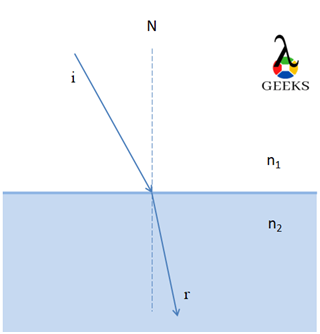
As the density of the medium varies, the wavelength differs, and the direction of the propagation of the wave changes. If the wavelength increases, the angle of refraction will exist greater.
When a wave travels from a denser to a rarer medium, the speed of light and hence the wavelength increases, and the refractive bending produced on bending the ray of light will be greater.
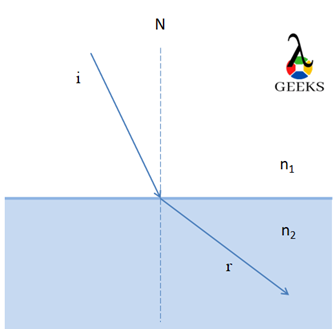
While a wave propagates from a rarer to a denser medium, the wavelength will decrease, and the refractive angle formed on angle the ray of light volition be smaller.
Read more on How To Notice Angular Acceleration From Athwart Velocity: Problem And Examples.
Frequently Asked Questions
Why does the refractive index of glass is more than the air?
The refractive index is determined by the change in the speed of light while traversing from a given medium.
The speed of the light reduces to a greater extent in the drinking glass compared to the speed of light in the air. Hence, the refractive alphabetize of a glass is more compared to air.
What will be the consequence on the refraction if the frequency of the wave increased?
The frequency remains constant on refraction and is inversely correlated to the wavelength.
If the frequency increases so the speed of the wave will reduce, and the wave volition divert towards the normal producing a small angle of refraction.
When does a ray of a low-cal disperse after refraction?
If the white lite traverses through the medium and emerges out at the same angle then the dispersion of light does not occur.
If all the components of the calorie-free emanating out from the medium at unlike angles then this phenomenon is called the dispersion of the calorie-free.
Why does the frequency of a light does non changes while propagating from higher density medium?
The speed of light decreases while traveling from the denser medium.
The frequency determines the propagation of light in time. Every bit the speed reduces the wavelength will also compress, thus the frequency remains constant.

How Does Density Affect Refraction,
Source: https://lambdageeks.com/effect-of-refraction-on-wavelength/
Posted by: fiorinifoused48.blogspot.com
0 Response to "How Does Density Affect Refraction"
Post a Comment